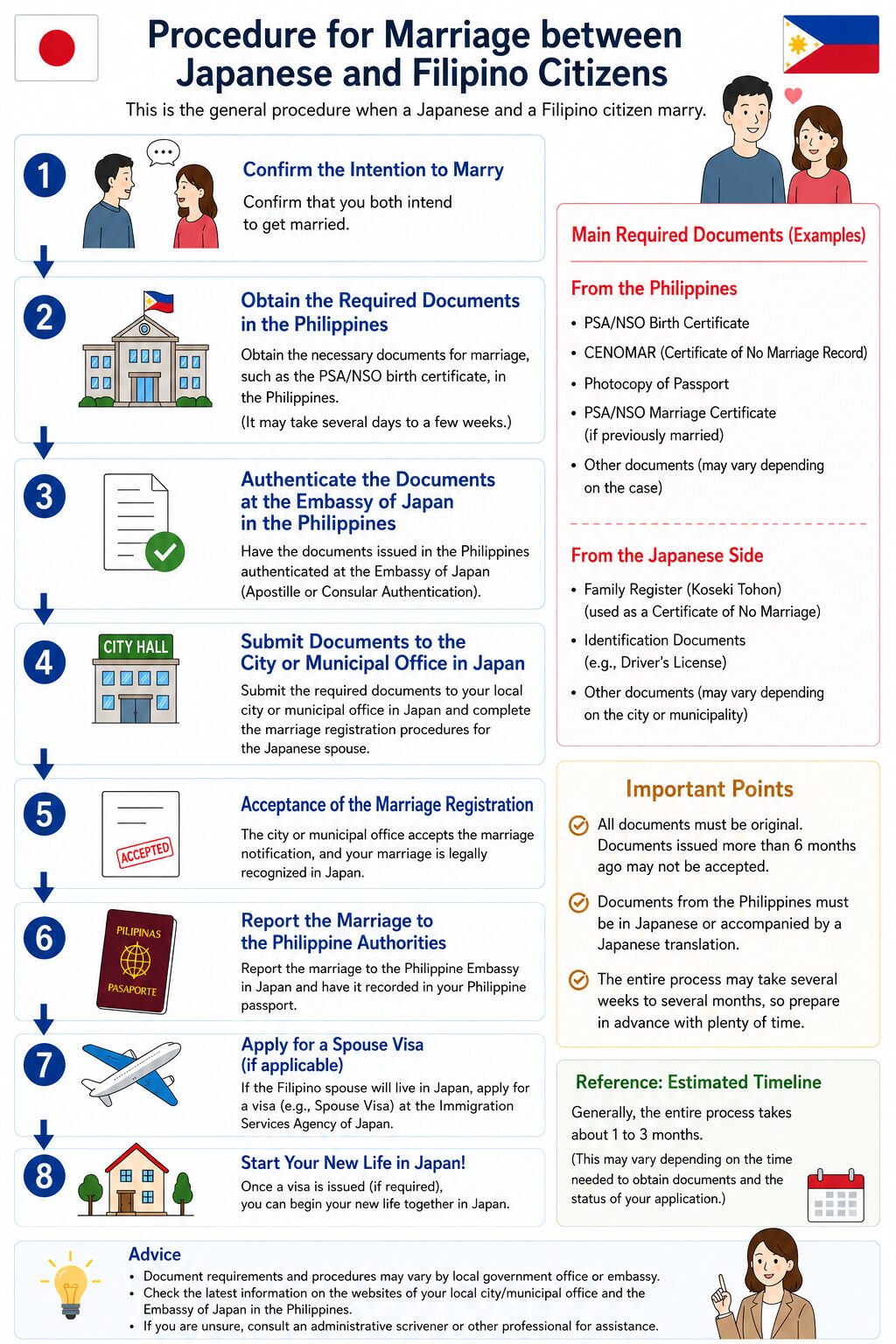
The only way to go from marrying a Filipino trainee to obtaining a visa!
Even when I tried to find something to refer to, it was difficult, and I proceeded with the procedures while wondering if I was doing it correctly, which resulted in me having to visit the government office many times.
In my case, I had no information and remained unclear, but based on my experience, reading this article will help you smoothly go from marrying a Filipino to obtaining a visa change.
- Step 1: Confirming the intention to marry
- Step2:Obtaining documents from the Philippine side
- Step 3: Document authentication at the Philippine Embassy in Japan
- Step 4: Submit your marriage registration to a Japanese municipal office.
- Step 5: Acceptance of the marriage registration
- Step 6: Reporting the marriage to the Filipino side
- Step 7: Applying for a spouse visa
Step 1: Confirming the intention to marry

In our case, we had to choose between separating or getting married before my wife’s internship contract expired, and we were able to decide to get married without any hesitation.
Step2:Obtaining documents from the Philippine side
Once we’ve confirmed your intention to marry, we’ll begin preparing the necessary documents.
When registering a marriage in Japan, you will need to obtain a Certificate of Legal Capacity to Marry (LCCM).
And in order to obtain it, you will need to get two more documents from the Philippine Statistics Authority.
- Cenomar
- Birth Certificate
In my case, my wife’s sister take it for me from the Philippines, and it arrived quickly via express mail in about a week.
Regarding these documents, there is nothing the Japanese side can do; they must be submitted by the Filipino side.
Step 3: Document authentication at the Philippine Embassy in Japan
Once you have obtained your Certificate of Single Status and Birth Certificate, you will then need to obtain a Certificate of Legal Capacity to Marry (LCCM) from the Philippine Embassy or Consulate in Japan.
I live in Kitakyushu City, Fukuoka Prefecture, and the nearest embassy or consulate is the Osaka Consulate. However, representatives from the Osaka Consulate regularly visit nearby Fukuoka City and Yamaguchi City, and I was able to apply for a Certificate of No Impediment to Marriage (LCCM) in Fukuoka City.
I found out where to find information about Outreach Program to that region on Facebook.
My wife says that all Filipinos use Facebook.
The Facebook account page is here.
For those living in rural areas, you can use this information to make a reservation here/ and complete the procedure in person.
Here are all the required documents.
- Completed application form
Click here for the original - Cenomar
- Birth Certificate Original and one copy
- Passport-sized Identification photo 3 pieces
- Passport Original and one copy
- Residence card Original and one copy
Step 4: Submit your marriage registration to a Japanese municipal office.
Once you receive your Certificate of Legal Capacity to Marry (LCCM), you can finally submit your marriage registration.
Here are the documents you need to submit to the Japanese government office.
- Marriage registration: Requires the signatures and seals (or signatures) of two adult witnesses.
- Identification documents for Japanese spouses: My Number Card, driver’s license, etc.
- Certificate of Single Status: Issued by the government of one’s home country or the embassy in Japan, this document certifies that there are no legal obstacles to marriage. A Japanese translation must be attached.
- Birth certificate: Varies by country. Attach a Japanese translation.
The question here is about the Japanese translation, which I translated myself.
If you’re not confident, it’s best to ask an administrative scrivener for help, but that will cost money.
I recommend trying to translate it little by little using the internet or working with your spouse.
If there is demand, I will also write an article about the Japanese translation.
Step 5: Acceptance of the marriage registration
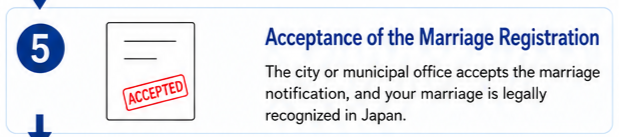
Once the marriage registration is accepted, proceed to step 6.
One thing that realized me again while writing this article is that a certificate of single status and a certificate of eligibility for marriage seem to be almost the same thing.
A certificate of single status serves that purpose, so if you see “certificate of eligibility for marriage (certificate of single status)” on other websites, you can understand that it means the same thing once it’s authenticated.
Step 6: Reporting the marriage to the Filipino side
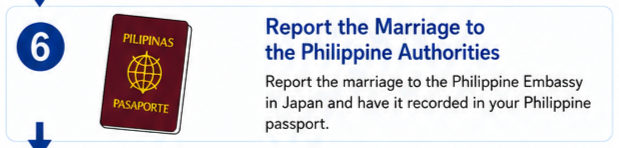
We’re almost there, let’s keep going!
You will also need to go to the Philippine Embassy.
This link, “Report of Marriage,” contains the original application form, which is what you need.
- Completed marriage registration form (Click here to download the form) – Original and 4 copies
- The passports of both husband and wife: original and four copies each.
- Certificate of Registered Matters of Marriage Registration (original and 4 copies of the marriage registration form with official certification from the local government office)
- A certified copy of the family register stating the fact of marriage: original and four copies.
- Four passport-sized photos of each spouse.
- Return envelope: 1 Letter Pack Plus envelope, 600 yen as of May 2026.
I couldn’t find any information about what a “certificate of registered matters” was, no matter how much I researched it.
Even when I explained to the Japanese government office that I needed it to report my marriage to the Philippines, they wouldn’t issue it, perhaps because it’s not required in other countries.
After it was finally issued, I realized it was just a copy of the marriage registration form with the government office’s stamp on it.
Step 7: Applying for a spouse visa
This is the last procedure you need to complete.
First, here are the things you will need.
- Application form for permission to change residence status – The form is here. (1 copy)
- Photo 1piece (Prepare a photograph that meets the specified standards and attach it to the application form before submitting.)
- One copy of the family register (certificate of all entries) of your spouse (Japanese national).
- One copy of the Report of Marriage issued by the Philippines.
- Documents proving the cost of living in Japan
- One letter of guarantee from your spouse (Japanese national).
- One copy of the resident registration certificate listing all members of the spouse’s (Japanese national) household.
- Questionnaire 1 copy https://www.moj.go.jp/isa/content/930003288.pdf
- Documents that confirm communication between the couple
- Present your passport
- Present your residence card.
The most difficult part of the process was gathering documents that confirmed the couple’s interactions.
Ultimately, I don’t know if it was true or not,
I understand that it’s necessary to prove that it’s not a marriage scam or a fake marriage,
but I read on some website that you need about 30 photos and their descriptions to prove it’s not a fake marriage, etc., so I prepared 30 photos and their descriptions as instructed, and I was able to obtain a spouse visa.
Another thing that isn’t particularly difficult, but can be confusing, is the documentation proving your living expenses in Japan.
All you need to do is bring the resident tax assessment (or non-assessment) certificate and tax payment certificate for the most recent year, issued by a Japanese government office.
However, the explanation that “most recent year” means the entire year, so you need the full year from last year, and the explanation that Japanese citizens also need these documents was very confusing.
The other documents passed without any problems, and I was notified to come to the immigration bureau at a later date to pick up my new residence card. I was then able to change my visa from a trainee visa to a spouse visa.


コメント